
National & Minnesota Report
Donald J Trump (R) latest attempt to cloak himself in grand, clearly divine imagery has not produced the awe he may have expected. Instead, it has exposed something far more fragile beneath the surface: a leader increasingly disconnected from the very people who once formed the bedrock of his support. Is this a reflection of his ego outpacing his reality.
For years, he has relied on exaggeration, bravado, and a cultivated persona of strength, but does this just portray the inherent weakness of his artifice? In this recent turn—leaning into imagery and rhetoric that suggests a kind of infallibility or chosen status—has struck a far different chord. Among critics, it has long been dismissed as an over inflated ego. Among former allies, however, it is now being interpreted as something more troubling: a genuine belief in his own myth.
This also could be a further reflection of his slipping into a delusional state of mind.
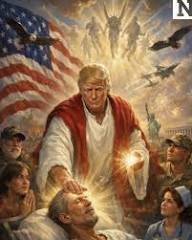
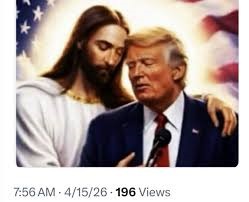
What makes this moment distinct is not outrage from his opponents—that has been constant—but discomfort from within his own ranks. Religious conservatives, once among his most loyal defenders, are increasingly uneasy. For many, the blending of political leadership with godlike symbolism crosses a line into blasphemy. It is one thing to support a flawed leader; it is another to watch that leader appear to elevate himself beyond accountability.
Trump’s schism with all Christians follows his reducing support among Catholics due to his attack on Pope Leo, for his opposition to the War with Iran, and the specifically the concept of this being a “Just War”. Let’s remember he already thought of himself in the Papacy.

This erosion of support comes at a time when external pressures are already mounting. Trump’s economic decisions, particularly his aggressive use of tariffs, have begun to ripple through the broader economy. What was framed as a bold strategy to protect American industry has translated, in everyday terms, into higher prices for consumers. Groceries, manufactured goods, and essential imports have all felt the squeeze. For many Americans, the promise of economic strength has given way to a reality of tightening budgets.
Layered on top of this is a foreign policy landscape that has grown increasingly volatile. Tensions with Iran escalated into open conflict following decisions widely viewed as avoidable. The consequences have been immediate and far-reaching. Oil markets reacted sharply, sending energy prices upward and placing additional strain on households already grappling with inflation.
Perhaps most consequential has been the instability surrounding the Strait of Hormuz—a narrow passage through which a significant portion of the world’s oil supply flows. Any disruption there reverberates globally, and even the threat of restriction has been enough to drive uncertainty and price spikes. The situation underscores how quickly geopolitical decisions can translate into domestic hardship.
Taken together, these developments paint a picture not of dominance, but of overreach. The self-styled image of invincibility begins to fracture when confronted with tangible consequences—rising costs, international instability, and waning trust.
In the end, the use of godlike imagery may prove to be less a show of strength and more a revealing miscalculation. Leadership, particularly in a democracy, depends not on elevation above the masses but on connection with them. When that connection is replaced with self-mythologizing, the distance grows—and once that distance becomes too great, even the most loyal followers begin to step back and reconsider what they are witnessing.